


很抱歉,没有找到 “” 相关结果
请修改或者尝试其他搜索词


设计单位 中国建筑西南设计研究院有限公司
项目地点 四川成都
建成时间 2025年
建筑面积 7768平方米
本文文字由中建西南院筑品提供。

When Educational Transformation Meets Urban Memory
成都七中,这座拥有百廿年历史的名校,以其“人文滋养,个性成长”的教育理念,培养了以多位院士为代表的众多杰出人才。林荫校区作为其核心本部,承载着一代代学子的青春记忆,也深植于成都的城市文化脉络之中。
Chengdu No. 7 High School, a prestigious institution with a 120-year legacy, has long fostered exceptional talents—including multiple academicians—guided by its educational philosophy of "Cultivating Humanity, Nurturing Individuality." As the school's core campus, the Linyin Campus not only embodies the youthful memories of generations of students but is also deeply rooted in the cultural fabric of Chengdu.

伴随学校的不断发展,既有校舍已无法满足日益多元的教育理念与空间需求,学校拟将临科华路的两栋原对外出租建筑(勤工楼与博雅楼)收回,改造为承载音乐、美术、科学、技术等多元学科教学的学科融合中心。
As the school evolves, its existing facilities can no longer accommodate increasingly diverse pedagogical needs. The institution plans to reclaim two buildings along Kehua Road—the Qingong Building and the Boya Building—transforming them into an Integrated Arts & Sciences Center dedicated to music, visual arts, science, and technology.

校舍的改造不仅关乎学校的发展,更牵动着无数校友与市民的情感。如何注入现代功能与绿色改造理念,同时在改造中保留这份珍贵的场所记忆,是本次工程的重要使命,也是对这座百年名校历史与文化的传承与致敬。
This renovation is not merely a functional upgrade; it is an emotional undertaking that resonates with alumni and citizens alike. The project’s paramount mission is to preserve this precious sense of place while infusing modern functionality and sustainable principles—a design approach that honors and perpetuates the history and culture of this century-old landmark.


The overwritten facade
位于校园南端的勤工楼与博雅楼,始建于上世纪80年代,先后做过电脑卖场、廉价酒店,立面被广告牌和“民国风”装饰反复覆盖,内部空间逼仄、布局零散,难以适配现代教学需求,像一段被反复涂抹的磁带。
Located at the southern end of the campus, the Qingong and Boya Buildings were constructed in the 1980s. Having served variously as a computer market and a budget hotel, their facades are obscured by layers of billboards and a superficial "Republican-era" aesthetic, while the interiors are cramped and fragmented, ill-equipped to support modern pedagogical needs—much like a cassette tape repeatedly recorded over.

博雅楼作为长145米、纵向连续31跨的超长横向单跨建筑,被鉴定为Csu级危房;且地铁3号线从负12米处正线穿越,带来持续振动干扰;加固的同时还需要抗震隔振设计;消防疏散也因为年代原因,无法满足现行规范;机电设施陈旧老化,裸露混乱,无法支撑新的智能化教学;建筑内外多次改造后也已与原图纸出入较大;外侧紧邻市政道路,内侧紧贴校园操场,施工操作面极度紧张;这些都给改造带来巨大挑战。
The Boya Building, a monolithic 145-meter-long structure spanning 31 bays, has been classified as a Grade Csu dangerous(critical structural instability) building, and with the Chengdu Metro Line 3 running directly beneath it at a depth of -12 meters, the project demanded not only structural reinforcement but also a sophisticated seismic isolation design to mitigate continuous vibrations. Compounding these structural woes, fire evacuation routes failed to meet current safety codes, and the outdated, haphazardly exposed MEP systems were incapable of supporting new intelligent teaching equipment. Furthermore, decades of piecemeal renovations had rendered the existing structure significantly divergent from the original blueprints, and with a municipal road flanking the exterior and the school playground immediately adjacent to the interior, the site offered extremely limited working space, presenting a formidable set of constraints for the renovation.


Structural Jacking
问题最多的博雅楼,设计的答案是“轻介入”:保留框架,卸掉荷载,把楼轻轻抬起来——用于改造的全国首例“三维隔震支座”被植入老楼,水平向隔震、垂直向隔振,地铁带来的振动得以衰减百分之八十,抗震性能更是提升到重点设防类。为了安装支座,整栋楼先被千斤顶顶起,支撑的钢管承担二层以上仅保留框架的全部重量,安装完成之后,再进行下一步工序。
The design team's response was a strategy of "light intervention": preserving the frame, unloading the load, and lifting the building gently. A pioneering "3D seismic isolation bearing"—the first of its kind used in a renovation project nationwide—was implanted into the old structure. This innovation provides both horizontal seismic isolation and vertical vibration damping, reducing subway-induced vibrations by 80% while actually upgrading the building's seismic performance to the "Key Fortification Category." To install these bearings, the entire structure was first jacked up. Steel pipe supports were then erected to bear the full weight of the upper floors, which retained only their original frames. Only after the bearings were securely in place did the next phase of construction commence.


A Fluid Generator of Interdisciplinary Fusion
结构松一口气之后,空间开始流动。改造原有狭窄通道和楼梯,并将两栋楼联通,形成“二层科技、三层音乐、四层美术”的垂直学科带;原来1.1米的走廊被拓宽至2.1米,在合适位置放大处理。
Once the structure breathed a sigh of relief, the space began to flow. The original narrow corridors and staircases were transformed to connect the two buildings, forming a vertical academic belt dedicated to "Technology on Level 2, Music on Level 3, and Art on Level 4." The original 1.1-meter-wide corridors were widened to 2.1 meters and strategically expanded to create thematic exhibition zones and student interaction spaces on each floor.


每层设置主题学科展示空间和学生交流空间,结合上下贯通的开敞楼梯,形成水平与纵向相互渗透的开放交流场所,增强空间通透感与连续性。
Combined with vertically connected open staircases, these interventions form horizontally and longitudinally open communication hubs, significantly enhancing spatial transparency.


教室不再固定,活动隔断5分钟即可完成“分—合”切换,可以每间教室独立授课,也可以合并成跨班级大教室,应对多样化的教学场景,提升空间利用率,也提供个性化学习与交流体验。同时在勤工楼5楼和6楼各设置学科融合教室及教师研修中心,提供更多舒适交流空间。
The classrooms themselves are no longer fixed entities. Operable partitions allow for "division-integration" switching in just five minutes, enabling independent teaching in individual rooms or the creation of large cross-classroom spaces to accommodate diverse pedagogical scenarios. Additionally, interdisciplinary integration classrooms and a teacher training center were established on the 5th and 6th floors of the Qingong Building, providing further comfortable spaces for exchange.


Sky Gallery
我们希望在满足学校功能要求的基础上,为校园留下具有独特有记忆点的空间。相比其他框架固定的楼层,原本由轻质铁皮临时搭建、可以向天空发展的博雅楼顶层是最具突破潜力的空间。为避免对原有基础增加过多重力荷载,并快捷准确地完成主体建造,设计选用钢结构在顶层重建美术教室和 “天空美术馆”。白墙、波浪状的屋顶与北向天窗,在开阔的美术展厅中,可以直接感受到光线的柔和与空间的浪漫。师生作品可以在此轮换展出,也可以移至一层临街横向橱窗,入夜亮灯后,行人将在不经意间,与一幅十七岁的画作不期而遇。
Beyond meeting the school's basic functional requirements, the design sought to create memorable spaces within the campus. Unlike the other floors with their fixed structural frames, the fourth floor of the Boya Building presented a unique opportunity for transformation—it was originally a temporary corrugated metal structure with an unobstructed view of the sky above. To avoid imposing excessive dead load on the existing foundations and to ensure rapid and precise construction, a steel structure was adopted to rebuild the art classrooms and the "Sky Art Museum" on this level. With its white walls, undulating roof, and long north-facing skylights, the expansive art exhibition hall offers a more open spatial experience, a lighter structural presence, superior lighting conditions, and a distinctive roofscape. Student and faculty works are rotated here and also displayed in the horizontal street-facing showcase on the first floor. As night falls, these displays are illuminated, allowing pedestrians to look up and admire the oil paintings created by 17-year-old students.


技术上屋面的钢梁延长,从悬挑端向下延伸吊柱,从上部吊起了二、三层拓宽部分1米宽的走廊楼板。如此一来,既解决了拓宽部分重力无法落地的问题,也因悬挑端的荷载,减少了顶层钢梁的跨中弯矩。
Technically, the steel beams of the roof were extended to create cantilevers, from which hanging columns were suspended to support a 1-meter-wide extension of the second and third-floor corridor slabs above. This innovative solution not only resolved the structural challenge of where to transfer the load of the extended corridors but also, by utilizing the counterweight of the cantilevered end, effectively reduced the mid-span bending moment of the top-floor steel beams.


An Anti-Instagrammable, Functional Façade
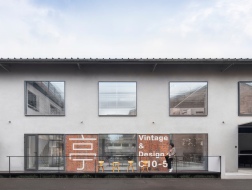
立面没有“网红”冲动。设计把校园既有红、白、灰砖元素按照比例抽象成三条水平色带,转译为立面上同色的穿孔铝板——既解决了学科融合中心的正东西晒问题,也隔绝了科华路高架和操场的大部分噪音;穿孔铝板后暗藏通风窗扇和新增的空调外机,以解决功能问题为导向对立面进行提升。
The façade makes no "Instagrammable" gestures. Instead, the design abstracts the existing campus palette of red, white, and gray bricks into three horizontal color bands, translated onto the elevation as perforated aluminum panels of the same hues. This solution not only mitigates direct solar radiation on the east-west facing interdisciplinary center but also insulates against the majority of noise from the Kehua Road viaduct and the playground. Behind the perforated screens, operable windows for ventilation and newly added air conditioning units are discreetly concealed, prioritizing functional resolution in the elevation's enhancement.

质轻、易维护的铝穿孔板搭配色彩丰富多样的闪银氟碳喷涂工艺,呼应城市历史文脉的同时,也为校园提供了科技感十足的未来气息。板距经过视线模拟,确保1.2米到1.9米视域无遮挡;同时在公共空间处穿孔板通过角度调节成水平状,视线更是完全打开,也为整个过长的立面提供一些节奏变化。
The lightweight, low-maintenance perforated aluminum panels, finished with a versatile silver fluorocarbon spray, echo the city's historical context while imbuing the campus with a futuristic, technological atmosphere. The spacing between the panels was determined through sightline simulations to ensure unobstructed views during 1.2m to 1.9m. In public spaces, the panels are angled to fully open the view, introducing a rhythmic variation to the otherwise long and monotonous elevation.

穿孔铝板的色彩也同样经过考量。七中校徽的主要元素是银杏叶,我们从银杏叶不同季相的色彩中获取灵感,将由黄转橙、继而变红的色彩,由上至下排布在立面上,使立面色彩丰富又统一,成为学校和而不同的“表情”。
The color of the perforated aluminum was also carefully considered. Drawing inspiration from the diverse shades of orange and red found on campus, we extracted the primary elements of the No. 7 High School emblem—the hues of ginkgo leaves across different seasons. These colors are distributed in a gradient across the façade through aluminum flashing, eaves, and perforated sunshades, resulting in a rich yet unified appearance that serves as the architectural expression of the school's spirit of "harmony in diversity."


勤工楼则是另一种情况。因其原始结构条件相对较好,设计选择了相对克制的改造策略——未将其所有围护结构拆除,仅将立面材料焕新,并在合适位置开窗保证采光。建筑上部主要采用了竖纹铝板,延续博雅楼金属板的质感和旁边家属区宿舍的横向条窗的肌理的同时,也增加一些二次质感的细节。
The Qingong Building presented a different scenario. Given its relatively sound original structure, the design adopted a more restrained and conservative renovation strategy—it did not demolish all the existing enclosure structures. Instead, new windows were strategically inserted into the façade to ensure adequate daylighting, and a fresh, revitalizing material was applied to the new elevational elements. The upper floors of the building are primarily clad in vertically ribbed aluminum panels. This choice not only extends the metallic texture of the Boya Building but also engages in a subtle dialogue with the horizontal window rhythms of the adjacent faculty dormitories, while simultaneously introducing a richer, secondary textural detail to the campus fabric.


Multidisciplinary Integration
解决完结构和疏散的安全性问题和立面的美观问题后,还有很多集成化设计的小巧思来进行建筑性能提升和完成度控制。
Having addressed the structural and evacuation safety concerns, as well as the aesthetic requirements of the façade, the design incorporates numerous integrated design "small ideas" to enhance building performance and control the overall level of finish.

集成化设计首先体现在系统的重构上。楼栋西侧原有的露天泳池因地铁工程已停用,并被盖上木板改作露天羽毛球场。本次改造保留了上部的活动场地功能,同时充分利用下方泳池原本的容积与防水基础,将其转化为消防水池及泵房,实现了存量空间的高效复用。电系统从宏观和微观层面进行能耗控制。宏观层面供配电系统在满足需求时部分利旧——博雅楼沿用原系统,勤工楼新设。
The first aspect of integrated design lies in the restructuring of systems. The original outdoor swimming pool on the west side of the building was decommissioned due to the adjacent metro construction. The school previously covered the pool with flooring to convert it into an outdoor badminton court. This renovation capitalizes on the pool's existing volume and waterproofing to transform it into a fire water reservoir, while retaining the upper level as a recreational area. Concurrently, the original auxiliary equipment room has been repurposed as a fire pump room. The electrical system implements energy control at both macro and micro levels. Macroscopically, the power supply and distribution system partially retains the old infrastructure where feasible—the Boya Building continues with the original system, while the Qingong Building features a new installation.

微观层面考虑以人为本进行成本控制——在人员使用频率较少的机房区设置就地开关;人员使用频率高、有场景变化需求的大空间、走廊、楼梯间采用智能照明控制系统进行集中控制管理,以满足使用者的个性化需求。勤工楼顶新设屋顶太阳能光伏系统,充分利用可再生能源发电。这些举措很好地实现闲置设施再利用,有效降低了改造成本。
Microscopically, a people-oriented approach to cost control is adopted: local switches are installed in equipment rooms with low personnel frequency; conversely, large spaces, corridors, and stairwells with high usage and variable scene requirements utilize an intelligent lighting control system for centralized management, catering to users' personalized needs. A new rooftop solar photovoltaic system has been installed on the Qingong Building to fully harness renewable energy. These initiatives effectively realize the reuse of idle facilities and significantly reduce renovation costs.

其次,集成化设计也体现在立面上。立面穿孔板背后设置可开启扇,保证室内的通风又不会破坏立面完整性。穿孔板外侧结合加岩棉金属板挑檐,形成自遮阳系统,有效减少太阳直射,降低室内得热。该挑檐同时具备隔声与吸音功能,可缓解东侧科华高架及西侧操场的噪声干扰。
The second aspect of integrated design is reflected in the façade treatment. Behind the perforated panels, operable windows are installed to ensure natural ventilation without compromising the façade's aesthetic integrity. Simultaneously, these windows form a self-shading system in conjunction with the rock wool metal eaves, preventing direct solar radiation. This configuration also mitigates noise pollution from the Kehua Viaduct to the east and the playground to the west.

此外,吸音金属挑檐可兼作反光板,改善建筑较暗区域的光环境,提升室内舒适度。勤工楼层高较低,我们采用设于窗边的分布式新风器与电动排烟窗减少水平风管对空间高度的挤占,保证净高和空间品质。通过这些被动式措施,实现遮阳、采光与通风一体化,显著改善声、光、热环境。
Furthermore, the sound-absorbing metal eaves act as reflectors to improve the light environment in darker areas. Given the Qingong Building's relatively low floor height, distributed fresh air units and electric smoke exhaust windows are installed near the windows to minimize the space occupied by horizontal air ducts, thereby guaranteeing headroom and spatial quality. Through these passive measures, the integration of shading, daylighting, and ventilation is achieved, significantly improving the acoustic, luminous, and thermal environments.
再者,集成化设计也体现在机电管线和建筑、结构、幕墙、装饰的紧密协作上。博雅楼平面不大,但由于建设标准的提高以及独特的锯齿天窗排水,建筑内部存在较多给水、屋面楼面落水、消防给水、空调凝水等各类水管,以及必备的电气和暖通管线,各类管线错综复杂,综合密度极高。
The third dimension of integrated design resides in intensive collaboration among MEP systems, architecture, structure, façade, and interior finishes. Despite the Boya Building’s modest floor area, upgraded construction standards and serrated skylight drainage requirements have formed a dense pipeline network (water supply, drainage, fire protection, AC condensate) plus essential electrical and HVAC conduits. Coupled with space encroachments from strengthened structural members, MEP layout optimization was imperative.

且结构梁柱因加固而断面增大,已经挤占了室内空间,为尽可能减少机电管线对室内空间的侵占,我们将各类给排水管线布置于建筑外墙外侧和有条件吊顶区域,并结合结构、幕墙的模数,将其统筹于外墙之外、立面穿孔板之后,并将其色彩进一步调暗,加强其与外侧银白色水平铝板的明度差异,使其消隐入背景墙面。如此一来,室内的使用空间得以完整、高效(不会因各种包管、检修而影响室内使用),服务设施的分散化布置保证了被服务空间的完整高效,且不影响立面效果。
To minimize spatial intrusion, water pipes were arranged externally or in suspended ceilings where feasible. Aligned with structural and façade moduli, these pipelines were integrated behind the elevation and dark-toned to contrast with silver-white aluminum panels, achieving visual recessiveness. This preserved intact, efficient interior space (free from pipe enclosures/maintenance disruptions) while ensuring uncompromised space functionality and façade aesthetics via decentralized service facilities.

还有一点特别的集成化设计是因为隔振带来的问题:因主体结构被三维支座断成了上下两部分,但所有的立管上下都需要跨越这结构断开所形成的“横缝”,如果不加注意,地震过后,恐会出现水管(上下水、消防水)大量错动开裂的情况;而若所有立管都按抗震柔性连接,对观感和成本影响又巨大。
A distinctive integrated measure addresses vibration isolation-induced challenges. The main structure, split into upper and lower segments by 3D bearings, forms a horizontal "structural gap" for vertical pipes to traverse. Seismic activity risks pipe displacement/cracking, while universal seismic flexible joints are visually and economically unfavorable.

针对这个问题,我们“水”分两路。将消防、给水系统上下分开;一层横管走地面,二至四层横管走勤工楼上楼后再横向走通,不共用立管。排水节点通过巧妙设计的断接雨水口“接水兜”,将结构变形量统筹其中,保证在最大变形范围之内,“接水兜”都能“兜”住插入其中的排水管。并在外侧,设计带有学校纹饰的穿孔板,将这一巧妙节点,以装饰的语言表现出来。
A "dual-path" water system strategy was adopted: fire protection and domestic water systems were vertically segregated, with first-floor horizontal pipes under the slab and 2nd–4th floor pipes routed via the Qingong Building, eliminating shared risers. Drainage nodes utilize "water-capturing pockets" at disconnected rainwater inlets to accommodate structural deformation and ensure water collection. Externally, school-emblazoned perforated panels conceal this joint, translating functionality into architectural expression.


七中林荫学科融合中心改造提升项目面积不大,但“麻雀虽小,五脏俱全”。不仅是教学理念与建筑理念的碰撞融合,更涉及建筑、结构、机电、幕墙、装饰等多个专业的协作。我们期待借由此次改造,为同学们创造更加丰富、生动的学习体验,激发同学们对素质拓展的兴趣和探索欲,增强对校园的认同和归属感。
Though modest in scale, the project is "small but complete in all essential parts." It not only involves the collaboration of multiple disciplines including architecture, structure, MEP (Mechanical, Electrical, Plumbing), curtain wall, and interior design, but also represents the collision and integration of teaching philosophy and architectural concepts. We aim to create a richer and more vivid learning experience for students through this renovation, stimulate their interest and curiosity in quality development, transform them from passive recipients of knowledge into active explorers, and enhance their sense of identity and belonging to the campus.
我们希望借助林荫七中在教育界的影响力,通过本次“轻介入”策略的改造提升,在延续校园文脉记忆、植入未来教育空间基因的同时,倡导并探索一种经济普适的价值观和技术路径,一种校园建筑改造的新范式:在空间、规范、造价三重夹缝里,用技术精准松绑,让空间回到教育本身。
Leveraging the influence of Chengdu No. 7 High School in the education sector, we hope that through the "light intervention" renovation strategy, while preserving the campus's cultural context and memories and implanting the genes of future educational spaces, we can advocate and explore an economical and universally applicable value concept and technical path—a new paradigm for campus building renovation: precisely loosening the constraints through technology amidst the triple pressures of structure, regulations, and cost, allowing space to return to the essence of education.
百廿名校的记忆被保留,新的故事刚刚写入。
The memories of this 120-year-old prestigious school are preserved, and new stories are just beginning to be written.

设计图纸 ▽


完整项目信息
项目名称:成都七中(林荫校区)学科融合中心改造
项目地点:四川成都武侯区
设计时间:2021年6月—2024年5月
建成时间:2025年
用地面积:1433平方米
建筑面积:7768平方米
业主单位:四川省成都市第七中学(易国栋、赵敏、陈帅、陈泉、门维婷)
代理业主:成都城投教育投资管理集团有限公司(倪宇、杨斌杰)
设计单位:中国建筑西南设计研究院有限公司
设计总负责人:黄怀海
设计副总负责人:黎琳璘
建筑专业:阎渊、宋然、林有为、钟易岑、胡静雯、王舒悦、李姗霓、何沁洋
结构专业:高永东、宗晓庆、陈宇豪
给排水专业:叶磊、蒲金晶
暖通专业:刘玉东、贺礼荣
电气专业:姚锋、陆萌、余洁、雷兰
幕墙专业:周春晓、刘芳萍、彭伟
建筑技术:史尤佳
建筑经济:孟祥臻、王香平
所有照片版权:阎渊
所有图片版权:中建西南院
版权声明:本文由中国建筑西南设计研究院有限公司授权发布。欢迎转发,禁止以有方编辑版本转载。
投稿邮箱:media@archiposition.com





上一篇:SLEEK斯李克上海展厅|WJID维几设计
下一篇:长租公寓研发样板间,小空间居住革命 / 峻佳设计