
很抱歉,没有找到 “” 相关结果
请修改或者尝试其他搜索词


设计单位 LYT-X Studio
项目地点 法国勒阿弗尔
方案状态 概念方案
建筑面积 31,000平方米
本文文字由设计单位提供。
Brise-Vent勒阿弗尔港湾博物馆位于法国勒阿弗尔历史滨水带,项目以“适应性再利用”为核心,将既有的工业港口构筑物转译为面向公众的文化设施,并重新嵌入城市的海洋与日常生活网络之中。设计不将其视为需被“封存”的遗产标本,而是把既有结构当作可持续生长的空间与基础设施资源,让当代文化使用与公共可达性在原有城市肌理上继续发生。
The Brise-Vent Havre Harbor Museum is a cultural project located along the historic waterfront of Le Havre, France. The project proposes the adaptive reuse of an existing industrial harbor structure, repositioning it as a public cultural facility integrated into the city’s maritime and urban context. Rather than treating the site as a preserved artifact, the project approaches the existing building as a spatial and infrastructural resource capable of accommodating contemporary cultural use and public access.
基地曾是港口工业与海运运作的重要节点;随着产业与港区功能迁移,建筑逐渐失去原有使命,与城市日常产生断裂。项目以“保留–增补”的方式回应:保留既有建筑作为最重要的历史层,同时引入清晰可辨的新介入以扩展公共使用能力,使历史肌理与当代更新在同一框架内保持彼此独立又相互支撑的关系。
The site occupies a former port area that once played a central role in industrial and maritime operations. As port activities evolved, the structure gradually lost its original function and became disconnected from daily urban life. The project responds by retaining the existing building as the primary historical layer while introducing new architectural elements that extend its capacity for public use. This strategy allows the historic fabric and contemporary intervention to remain legible as distinct yet interrelated components within a single architectural framework.
空间组织强调连续性与渗透性:通过一条可持续行走的空间序列,将城市、滨水步道与港湾彼此串联;公共动线被安排为“穿越与通行”,而非将活动压缩在单一封闭体量中。博物馆因此更像滨水系统中的一段公共基础设施,既承载策展与活动,也容纳日常的停留与通行。
The architectural organization establishes a continuous spatial sequence connecting the city, the waterfront, and the harbor. Public circulation routes are arranged to allow movement across and through the site, rather than concentrating activity within a single enclosed volume. In this configuration, the museum functions as part of the broader waterfront network, supporting both programmed cultural activities and informal public use as part of everyday urban life.

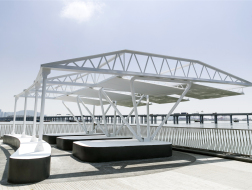
项目最具识别度的构成是对既有弧形屋顶的延展:屋顶被拓展为沿水岸展开的连续檐篷,组织流线、提供遮阴,并在城市步行路径与港口活动之间建立具有尺度与方向感的过渡界面。檐篷之下布置半室外公共空间与受保护的庭院,形成从城市滨水步道与水面双向进入的开放场所;庭院在博物馆闭馆后仍可开放,确保场地持续作为城市公共空间运行。室内外边界更多通过空间连续性来定义,使文化活动可以自然嵌入城市节律。
A defining architectural element is the extension of the existing curved roof into a continuous canopy along the waterfront edge. This canopy structures circulation, provides shaded outdoor areas, and establishes a transition between urban pathways and harbor activity. Beneath the extended roof, a series of semi-open public spaces and a sheltered courtyard are introduced, allowing access from both the city promenade and the water. The museum is positioned as a connective public environment rather than a destination separated from its surroundings. Public accessibility is treated as a central design parameter throughout the project. The courtyard remains accessible beyond museum operating hours, enabling the site to function as an open civic space. Thresholds between interior and exterior areas are defined through spatial continuity rather than visual transparency alone. Exhibition halls, performance spaces, and public circulation zones are arranged to accommodate both curated cultural programs and informal daily use, allowing cultural activity to intersect with the rhythms of the city.


功能配置包含常设与临展展厅、表演空间、可转换的文化与活动空间,以及与滨水码头相连的室外公共区域。整体以清晰的动线与空间导向组织参观与使用,并通过面向港湾的视线关系强化建筑与海事语境的持续对话,从而在“日常可达”与“文化目的地”之间取得平衡。
The program includes permanent and temporary exhibition halls, a performance hall, flexible event and cultural spaces, and outdoor public areas connected to the waterfront dock. This mix supports a range of cultural formats while maintaining adaptability over time. Interior spaces are organized to provide clear circulation and orientation, with views toward the harbor reinforcing the relationship between the building and its maritime context.

在项目推进过程中,LYT-X Studio围绕“历史织体–公共可达–长期城市使用”的关系建立了明确的建筑立场;在此框架内,创始人唐定东主导了项目层面的结构性梳理,并与联合创始人李则慧、许海生共同创作,将该立场落实为空间组织、流线系统与环境策略,使既有基础设施能够适配当代文化使用。
Throughout the project’s development, a defined architectural position addressing the relationship between historic fabric, public accessibility, and long-term urban use was established within LYT-X Studio. Within this framework, Founder Dingdong Tang contributed to structuring these relationships at the project level. The position was developed through collaboration with co-founders Zehui Li and Haisheng Xu and translated into spatial organization, circulation systems, and environmental strategies supporting contemporary cultural use within the existing infrastructure.

环境策略以“少拆少建、以用代新”为基本原则:既有结构的再利用与新增建造量的控制本身即构成减碳路径;延展檐篷提供被动遮阳并改善滨水微气候,庭院与屋面开口引入自然采光,通风策略则借助海岸风环境提升空间舒适性。这些措施与运营维度的长期可持续相衔接,也使项目能够在未来城市更新中保持适应性与延展性。
Environmental considerations are integrated through the reuse of the existing structure and the reduction of new construction. The extended roof canopy provides passive shading and contributes to moderated microclimatic conditions along the waterfront. Courtyards and roof openings introduce natural light into interior spaces, while ventilation strategies take advantage of coastal air movement. These measures support functional performance while aligning with long-term operational considerations.


设计图纸 ▽


完整项目信息
Design Year: 2024–2025
Status: Concept Stage
Program: Museum (permanent and temporary exhibition halls), performance hall, public plaza, waterfront dock, flexible event and cultural spaces
Gross Floor Area: 31,000 m²
Design Team: Dingdong Tang (唐定东), Zehui Li (李则慧), Haisheng Xu (许海生)
Site Area: Harbor redevelopment site (existing industrial waterfront structure)
Floors: 4 levels (including 1 underground level)
Building Height: 24 m
Structure: Steel and reinforced concrete
Facade / Envelope: Glass curtain wall system with extended curved roof canopy
Location: Le Havre, France
本文由LYT-X Studio授权有方发布。欢迎转发,禁止以有方编辑版本转载。



上一篇:三亚市大东海片区城市更新概念规划设计国际竞赛
下一篇:一间很小的24h书店 / 实在建筑设计工作室