


很抱歉,没有找到 “” 相关结果
请修改或者尝试其他搜索词


项目名称 历史奥伯阿姆特大街博物馆新馆
设计单位 wulf architekten
项目地点 德国罗伊特林根
建成时间 2025年
本文英文原文由wulf architekten提供,由有方编译。
位于Oberamteistraße 28至32号的一排历史住宅,以及曾位于34号地块、但已于1972年拆除的“石屋”地下室,共同构成了德国南部最古老的木构架住宅群之一。这些建筑遗迹可追溯至12世纪和13世纪,即罗伊特林根建城之时。因此,这一建筑群是德国南部最古老的连排房屋之一,真实地反映了几个世纪以来建筑与生活文化的发展历程。
The historic row of houses at Oberamteistraße 28–32, along with the surviving basement of the “Stone House” at Oberamteistraße 34 that was demolished in 1972, are among the oldest and most interesting buildings in the former free imperial city of Reutlingen. These architectural artifacts date back to the 12th and 13th centuries, when the city of Reutlingen was founded. The ensemble is therefore one of the oldest rows of houses in southern Germany, authentically reflecting the development of building and living culture over the centuries.


此次修复工程在遵循建筑遗产保护原则的前提下展开,包括对既有建筑的修复,以及在原角楼旧址上新建一座建筑。建筑整体被用作博物馆,其中这些旧建筑本身即为展品,展示了700余年的城市、文化和建筑历史。
The rehabilitation, which follows historic preservation criteria, has also required the construction of a new corner building where the former “Stone House” once stood, which shores up the surviving historic ensemble and protects it from collapse. The old buildings serve as a museum and are themselves exhibits, displaying over 700 years of urban, cultural, and architectural history.


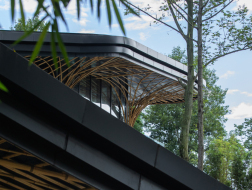
新建筑的外观设计低调内敛。其内部结构由木质桁架构成,既支撑着相邻的房屋群,又重现了这座历史建筑已消失的原貌。新建筑为通往旧建筑提供了无障碍通道,并为小型活动提供了空间。
The new building’s outward appearance is restrained. The internal structure consists of wooden trusswork that braces the adjoining row of houses and reestablishes the lost form of the historic house. The new building facilitates barrier-free access to the old buildings and provides space for small events.


屋面与立面采用一体化的“海狸尾”浇铸玻璃瓦片覆盖。
The roof and facades are clad with a homogeneous layer of cast-glass “beaver-tail” tiles.


在不同的入射光、反射条件及室内照明下,背后的木结构或隐或现,使建筑呈现出半透明或如幻影般闪烁的效果——赋予其一种如幻如梦的神秘气质,宛如一只奇幻的幻兽。新设计的外立面让内部空间显得朦胧,仿佛一段遥远的记忆。那些曾亲历老宅的人们记忆中仍存留的印记,如今得以重新展现在后世子孙面前。
Depending on the conditions of incident light, reflection, and interior lighting, the wooden trusswork behind it is more or less visible, and the building appears diaphanous and iridescent – giving it a mysterious quality, like a chimera. The newly designed outer skin makes the interior seem blurry, like a distant memory. Something that persists in the memories of those who still knew the old house is made visible again for future generations.


新建筑那几何结构复杂、具有承重功能的木结构,是通过参数化设计开发的。该结构的设计旨在使建筑需求与构造逻辑精准契合,并遵循清晰的功能逻辑:由斜向和水平交错的木构件构成的三层渐变式底层结构,承载着外部“海狸尾”玻璃瓦片覆层,以抵御恶劣天气。
The new building’s geometrically complex, load-bearing wooden structure was developed parametrically. The architectural requirements and constructive logic align precisely. A triple-layer, gradually dissipating substructure of diagonally and horizontally overlapping wooden members carries the glass beaver-tail tiles as external cladding for weather protection.


该建筑无需设置保温层或空调系统,同时也作为历史地下室的保护性围护结构。沿建筑外表面设置的开放缝隙,实现了自然通风与排烟,无需依赖机械设备。该建筑遵循“从摇篮到摇篮”(C2C)的设计与可持续性理念,以实现循环利用。因此,所有连接均采用螺栓固定,以便于拆卸。建筑设计中尽可能避免使用混凝土,仅在结构必需时才予以采用。本项目得到了联邦“国家城市建设项目”(Nationale Projekte des Städtebaus)的支持,从而得以保护并升级德国南部最古老的半木结构房屋群之一。
No thermal insulation or air conditioning is required in the new building, which also serves as a protective enclosure for the historic cellar. The building utilizes only natural ventilation and smoke extraction through open joints across its entire exterior. The building was designed for circularity in accordance with the Cradle to Cradle (C2C) design and sustainability concept. Thus, all connections are screwed together so they can be easily disassembled. Concrete was generally avoided and only used where structurally necessary. The Historical Oberamteistraße Museum project is supported by the federal program “Nationale Projekte des Städtebaus” (National Urban Development Projects), enabling it to preserve and upgrade one of the oldest rows of half-timbered houses in southern Germany.

设计图纸 ▽


完整项目信息
Project name: Historical Oberamteistraße Museum in Reutlingen, New Building
Competition: 12 2017 / First Prize
Start of planning: 10 2018
Completion: 2025 (New Building), 2029 (Old Buildings)
Client: Stadt Reutlingen
Location: Oberamteistraße 28-34, 72764 Reutlingen
Planning team: Stephan Burger (PL), Philipp Stute (DPL), Nicole Cao, Antonia Dürig, Hannah Esch, Junjie Long, Michael Mayer, Kübra Mercan, Damla Mirik, Nova Michalski, Simon Muller, Weiyan Wang, Maria Wyller
ARGE Oberamteistraße: wulf architekten gmbh, Stuttgart; Ingenieurbüro Grau GBR, Bietigheim-Bissingen
Structural engineering (New Building): str.ucture, Stuttgart
Restoration in line with monument preservation guidelines: strebewerk. Architekten GmbH, Stuttgart
Landscape architecture: Bäuerle Landschaftsarchitekten, Stuttgart
Project management: Hitzler Ingenieure, Stuttgart
HLS planning: IB Wienand, Reutlingen
ELT planning: IB Köhler, Leonberg
Elevator planning: planR, Ditzingen
Fire protection: Brandschutz Consulting, München
Building Physics: Kurz und Fischer, Winnenden
Model: Béla Berec, Stuttgart
Photos: Brigida González for wulf architekten
本文英文原文及部分图片由wulf architekten授权有方发布,由有方编译。欢迎转发,禁止以有方编辑版本转载。部分图片源自网络,若有涉及任何版权问题,请及时和我们联系,我们将尽快妥善处理。邮箱info@archiposition.com





上一篇:纽约艺术家工作室|水平线设计
下一篇:奥雷·舍人在建方案:融美术馆,深圳全新文化地标